Gypsum is one of the most extensively used construction and building material. Gypsum-based materials offer versatility, ease of application and excellent finishing properties, from smoothing interior walls to manufacturing different building products. The two common terms used are Gypsum powder and plaster of Paris. They are closely related, but they are not exactly the same.
Builders, contractors, architects and buyers can find the right material for their specific applications by knowing the difference between gypsum powder and gypsum plaster.
What Is A Gypsum Powder?
Gypsum powder is a fine powder processed from naturally occurring gypsum mineral. It is mainly composed of calcium sulphate dihydrate (CaSO₄·2H₂O). Depending on the industrial application the raw gypsum is mined, crushed, ground and processed.
Gypsum powder is a very important raw material in many industries. In construction it is further processed to form gypsum plaster, plasterboards, gypsum blocks, ceiling products and other building materials.
Besides construction, gypsum powder can also find use in industries like cement manufacturing, agriculture, ceramics, and other specialised applications, depending on its grade and specifications.
The quality of gypsum powder varies in purity, particle size, moisture content, chemical composition and processing method. So it is necessary to choose the right grade to get repeatable results.
What Is Gypsum Plaster?
Gypsum plaster is a building material made from gypsum, specially processed and prepared for the purpose of plastering walls and ceilings. In manufacture, gypsum is heated under controlled conditions to drive off some of the chemically combined water. Such a process is called calcination and yields calcium sulphate hemihydrate.
Gypsum plaster mixed with the right amount of water makes a workable paste. This paste can be spread directly onto appropriate surfaces of walls and ceilings. As it sets it hardens and produces a smooth, even finish.
One of the main benefits of gypsum plaster is that it can deliver a high quality surface appropriate for interior finishing and lessen the need for multiple traditional plastering phases for some applications.
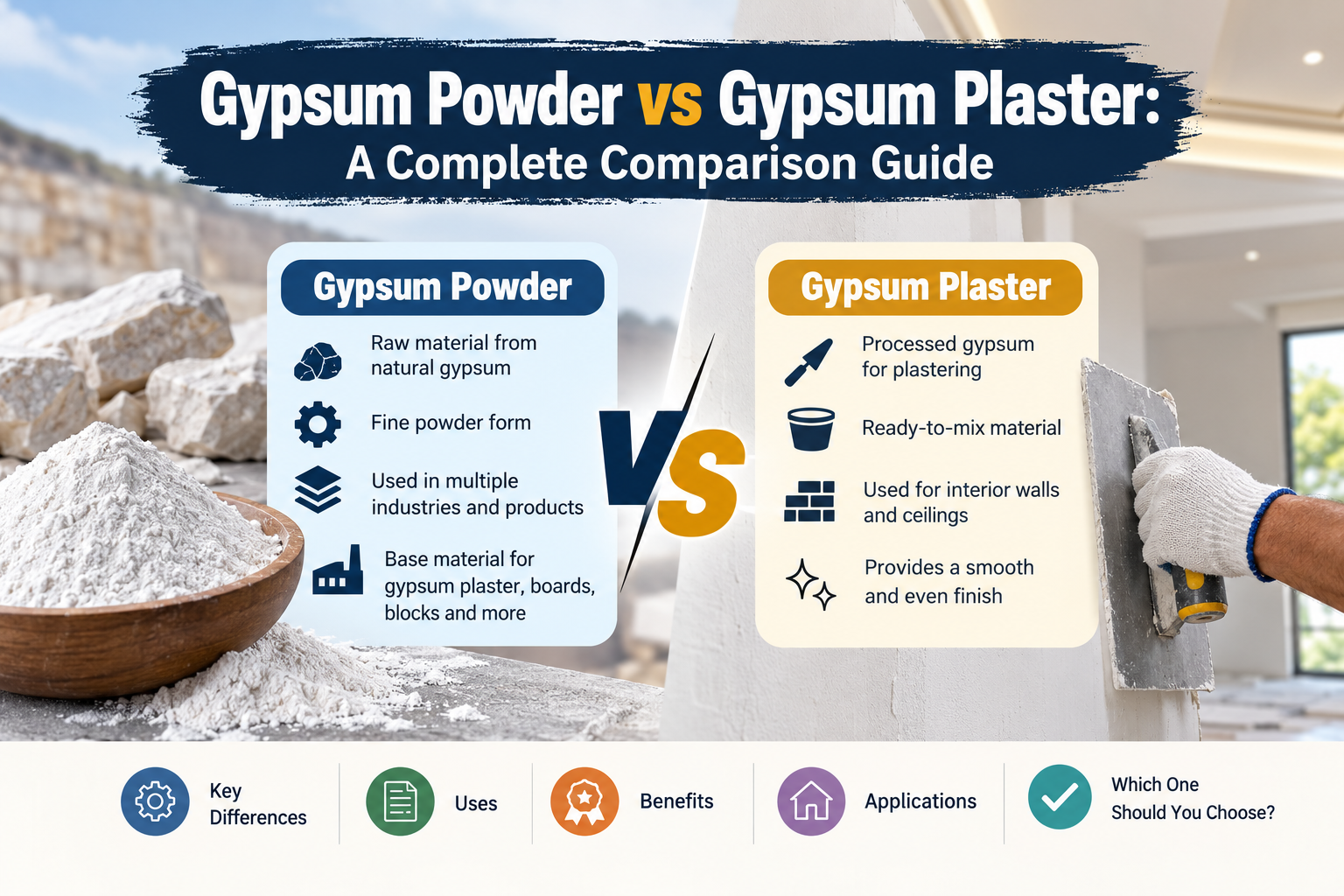
Gypsum Powder vs Gypsum Plaster- Key Differences
The key difference is in their form, processing and intended use.
Gypsum powder is a generic term for raw or processed gypsum material which can be used to produce different products. Gypsum plaster, in contrast, is specially processed and formulated for plastering applications.
Another significant difference is the application. Gypsum powder can be supplied for manufacturers for construction materials, cement or other industrial uses. Gypsum plaster is usually supplied in a form ready for mixing for use on interior walls and ceilings.
Their specifications could also be different. Gypsum plaster requires suitable setting time, workability, consistency, adhesion and finishing characteristics while the gypsum powder specifications depend highly on the final product or industrial process for which it will be used.
Advantages of gypsum powder
Gypsum powder is highly valued for its versatility. It can be used as a raw material for a variety of construction products and industrial applications based on gypsum.
Major advantages include ease of processing, uniform composition, compatibility with several manufacturing processes, and availability for different applications depending on the quality and grade.
Advantages of Gypsum Plaster
Gypsum plaster is widely used in the modern interior construction because of its smooth finish and ease of application. It can finish walls and ceilings well and may help speed up finishing time over some traditional plastering methods.
Gypsum plaster also has useful fire and thermal resistant properties. Gypsum contains chemically bound water that is released as vapour under high temperatures. The release of water vapour may improve the fire resistance of gypsum-based building systems.
So which one should you pick?
Choosing between gypsum plaster and gypsum powder is completely your application.
If you need gypsum as a raw material for the production of construction products or for an industrial process, gypsum powder may be your answer. If you need interior wall or ceiling plastering specifically, a properly formulated gypsum plaster is usually more appropriate.
Before you purchase either material, you should consider things like purity, particle size, set time, strength, application needs, and consistency of the supplier.
Conclusion
Gypsum powder and gypsum plaster are produced from the same mineral but are used for different purposes. Gypsum powder is a largely versatile raw material, whereas gypsum plaster is a processed product based on gypsum, which is used for plastering purposes.
Also Read: uses of gypsum powder in construction uses benefits significance
Knowing the difference makes it easier to choose the right material, which in turn leads to better application performance and better results for construction and manufacturing projects