Gypsum powder has become an important material in the modern construction industry due to its versatility, smooth finishing properties, ease of application and performance in interior building systems. It is widely used in residential, commercial and industrial projects for applications such as wall plastering, false ceilings, dry wall and decorative elements.
The various uses of gypsum powder in construction make it easier for builders, contractors, architects and developers to choose the right materials for efficient and quality construction.
Gypsum Powder – What Is It?
Gypsum powder is made from natural gypsum, a mineral which is predominantly calcium sulphate dihydrate. Natural gypsum is crushed and heated under controlled conditions and ground into a fine powder for use in construction.
When gypsum powder is mixed with the right amount of water it forms a paste that can be worked and that gradually hardens and sets. This property makes gypsum especially suitable for plastering, moulding, surface finishing, and the production of gypsum building materials.
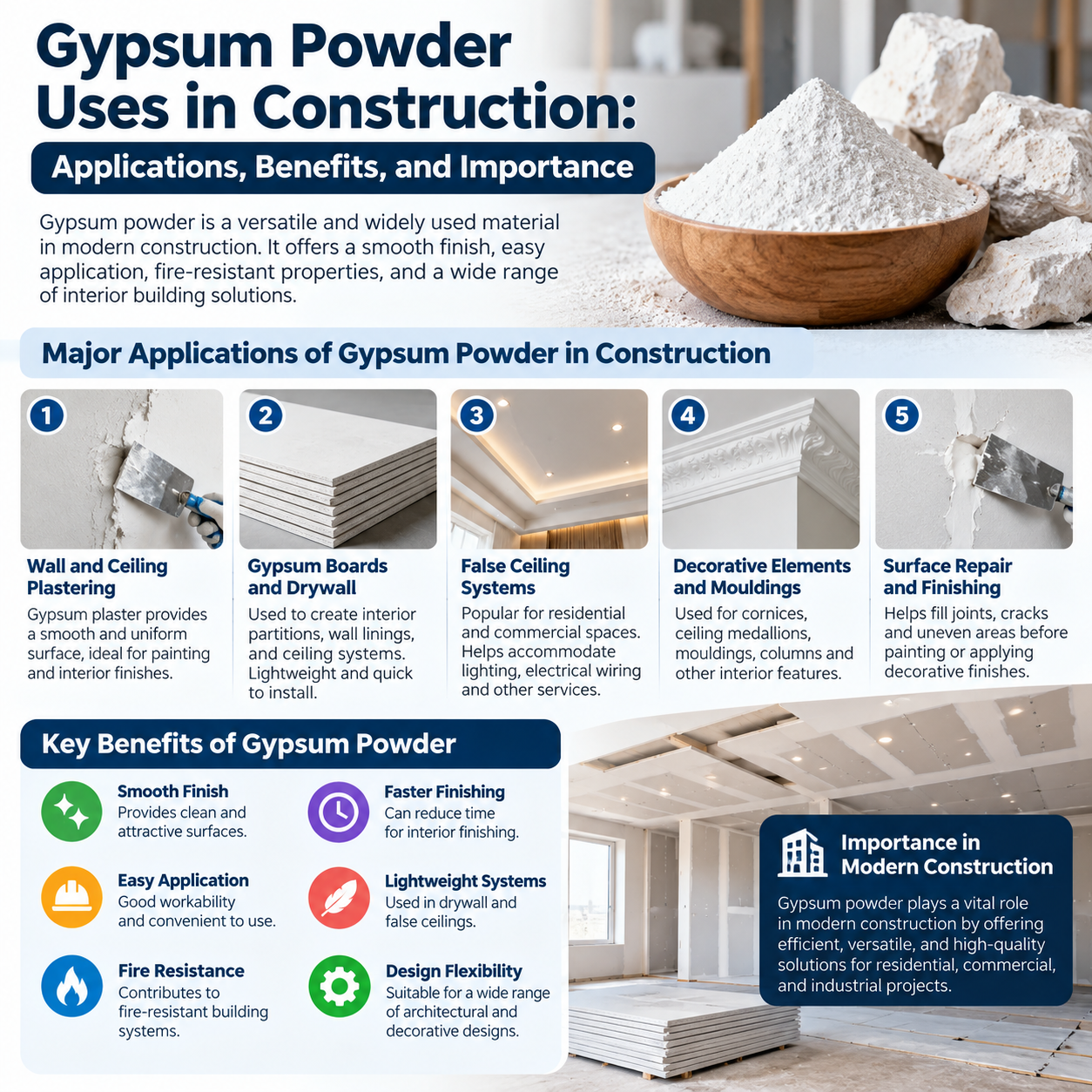
Gypsum Powder Major Applications in Construction
1. Plastering of Walls and Ceilings
Inside the building, walls and ceilings are plastered with gypsum powder. Gypsum plaster can give a smooth and even surface suitable for painting and other decorative finishes.
The good workability makes it useful for getting clean interior surfaces in homes, offices, hotels, hospitals, educational institutions and commercial buildings.
2. Plasterboard and Gypsum Boards
Gypsum powder is the primary raw material for the manufacture of gypsum boards, commonly known as drywall or plasterboard.
Gypsum boards are extensively used for interior partition, wall lining and ceiling systems. They are lightweight and easy to install, making them a popular choice for modern construction projects where speed and flexibility are key.
3. Ceilings – Suspended Systems
Gypsum based products are extensively used for false ceiling in residential and commercial places.
False ceilings can improve the overall look of interiors and also provide space for housing lighting, electrical wiring, air-conditioning components and other building services. Gypsum offers designers the choice of different ceiling shapes and architectural styles.
4. Ornamental elements and mouldings
The gypsum powder can be formed into different forms, which makes it ideal to use for decorative architectural elements.
Often used for interior features such as cornices, ceiling medallions, mouldings, decorative panels, columns etc. Because it is so easy to mould, designers can create intricate patterns and still have a smooth surface finish.
5. Surface Repairs and Finishing
Gypsum-based compounds are also used for surface finishing and minor repairs. They help fill joints, small cracks, holes and uneven areas before painting or applying other decorative finishes.
This application is particularly useful when a clean and consistent interior surface is needed.
Gypsum Powder Benefits in Construction
There are many practical and performance reasons why gypsum is so widely used in construction.
Gypsum gives a really smooth finish and is quite easy to work with. In appropriate applications it also offers a reduction in time for interior finishing when compared to some of the conventional methods.
One important characteristic of gypsum is that it contributes to fire resistant building systems. Gypsum has water chemically combined in its crystal structure. As this water is heated up it is slowly released as steam which helps to retard heat transfer through gypsum based assemblies.
Gypsum products are also extensively used in lightweight construction systems. In some internal applications, the use of drywall partitions and false ceilings can minimise the reliance on heavier masonry systems.
Quality Gypsum Powder Importance
The performance of gypsum products is greatly influenced by the quality of the raw material. Factors such as purity, particle size, setting time, consistency, moisture content and storage conditions can influence the final application.
Therefore, construction companies and manufacturers should choose high-quality gypsum powder that meets the technical requirements of the intended application.
Storage is equally important. Gypsum powder generally is stored in dry conditions and protected from excess moisture to maintain usability and performance.
Conclusion
This is why gypsum is still a very commonly used material in modern day building projects as the powder has so many uses in construction. Gypsum offers versatile solutions for a variety of interior construction needs, from wall plastering and gypsum boards to false ceilings, decorative mouldings, partitions and surface finishing.
Its smooth finish, workability, design flexibility and role in fire resistant and lightweight building systems make it a valuable material for builders, contractors, architects and developers.
Also Read: drywall gypsum screws types uses benefits buying guide
Select the right quality and specification of gypsum powder for each application to ensure reliable performance, consistent finishes and efficient construction.